Robertus Fludd (1574 – 1637)
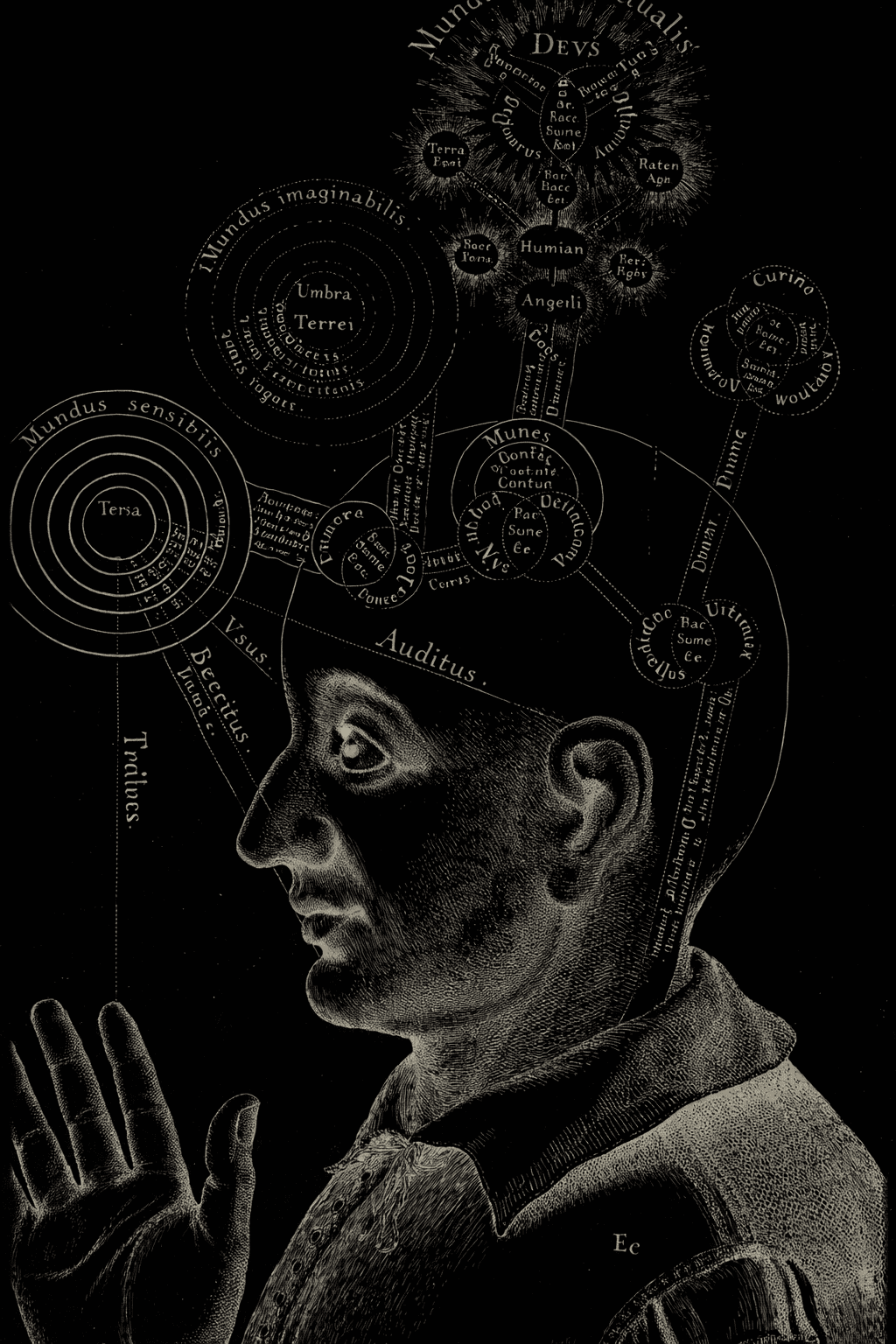
Robertus Fludd belonged to that excellent age in which people were still allowed to know everything, or
at least to attempt it with confidence and ink. For our purposes, what maters is that he tried to
describe the mind as a real working structure, not as a fog with opinions.
What makes Fludd interesting now is not the theology, however heretical, but the machinery hidden inside
it. He imagined cognition as a sequence: the senses bring material in, imagination gives it form, reason
sorts it, memory stores and reworks it. One notices, with a slight smile, that this is already
suspiciously close to a processing model. Input, transformation, organization, retrieval. Seventeenth
century metaphysics can sometimes resemble future software wearing ecclesiastical robes.
He also treated the mind as something spatial. Thoughts were not vague fumes drifting through a skull
for decorative purposes. They moved through chambers, reflected, combined, settled into ordered places.
Memory, in this account, was an active architecture. It did not merely preserve what had been thought.
It helped produce what could be thought next.
Anyone who has seen one of Fludd’s diagrams will recognize the pleasure here: he wanted ideas to live
somewhere, to stand in relation to one another, to form a structure one could almost walk through.
That is probably where his real charm lies. Fludd gave imagination a serious role. It was not a childish
extra, not a lounge area for fantasy, but a central faculty for simulation, projection, and invention.
He understood that intelligence requires more than storage and logic. It also needs the capacity to
stage possibilities internally before the world has agreed to them. The age of AI, which likes to
congratulate itself for rediscovering old truths in cleaner fonts, may permit him a quiet nod.
So Fludd belongs here because he offers an old intuition that still feels fresh: the mind is not a
bucket for facts, but a system for shaping them. He looked for hidden order, drew it when words seemed
too timid, and treated thought as a designed environment rather than an accidental blur. That seems a
respectable ancestor for anything trying to understand intelligence without pretending the mystery has
already been solved … or that it inevitably must be.
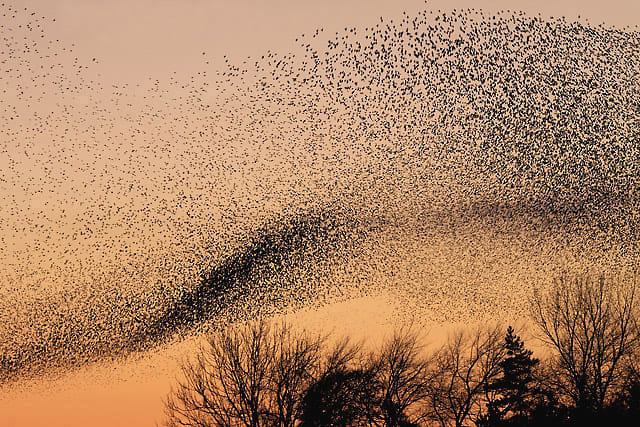
Image: Walter Baxter / A murmuration of starlings at Gretna / CC BY-SA 2.0
Murmurations: Structural Convergence in Biology, Arithmetic, and AI
Look at the sky for a moment. Thousands of starlings move at once, and somehow the whole thing feels
less like a traffic jam and more like a sentence. No bird is in charge, nobody is carrying a clipboard,
and yet a form appears. This image seem to visually match what AI is doing with words.
Scientists explain Starling murmurations through simple interactions among neighboring birds, and that
account is powerful, but might still be wrong. Even so, the visual impression remains striking.
Coherence appears at a scale larger than any individual participant, which is exactly why the phenomenon
stays interesting.
Mathematics offers an echo of this. In some areas of number theory, aggregated data produces structured
oscillaEons that researchers have also called murmurations. The point is not that birds, numbers, and
models are secretly the same thing. The point is that very different systems can display the same broad
trait.
Language models belong in that conversation. They generate text word by word, yet the result often holds
together across far larger spans. Themes persist, structure appears, meaning travels. We can observe
that clearly while remaining modest about final explanations, which is usually a better habit than
declaring victory over reality after one good demo.
So the name Flud Starling signals a preference. Flud for the search for hidden structure. Starling for
the visible emergence of order from many local interactions. We are interested in systems that produce
order without pretending the mystery has been solved. Socrates might have approved, or at least raise an
eyebrow in the right direction.

Our focus
We are interested in helping people think, and make formidable people great. That sounds obvious, which
is usually a good sign. The modern world spends a great deal of energy dreaming of a future in which
human judgment is quietly removed from the premises, preferably by people who have never had to make an
expensive decision themselves.
Our attention goes elsewhere. We care about serious work, the kind where errors have a pulse, a price,
or a consequence that survives the next quarterly presentation. In those environments, the point is
rarely to remove the human being. The point is to give the human being better reach, better clarity, and
a better chance of seeing the weak point before it becomes public.
So we are drawn to systems that sharpen thought, extend precision, and improve execution for people
already carrying real responsibility. A good tool, in our view, does not replace judgment. It gives
judgment a longer arm. It helps experts notice more, structure better, and act with a little less
friction and a little more force. Small gains here do not stay small for very long.
This also means we are broadly unimpressed by fashion. We have no particular urge to join the parade of
products built to automate the trivial, decorate the obvious, or make everyone ten percent faster at
something that should perhaps not exist in the first place. The crowd is welcome to enjoy itself. Crowds
often do.
We prefer a different path. We work on solutions that respect human agency, keep responsibility visible,
and make strong operators more capable in situations that actually matter. That is the general idea. It
is not fashionable enough for a slogan on a tote bag, which is one of its better qualities.
So our path is fairly simple. We prefer consequence over fashion, rigor over convenience theater, and
human agency over systems that obscure who is actually responsible. Most will chase automation
efficiency, a few will aim for effectiveness. We are more interested in developing capabilities that
holds up when the stakes are real. We aim to do what others cannot, we rejoice when we see others
attempting the same and will lend them a hand if we can.
We will take on what remains; that which simply cannot be done. And we know that we don't know how, and
that is all we now know. Thus, we sail into the unknown to discover what is there, so that others may
follow.